
Banking on Climate Chaos 2026: World's Largest Banks Financed $906 Billion in Fossil Fuels Last Year
Every year, a coalition of research and advocacy organizations publishes Banking on Climate Chaos, the most comprehensive public accounting of how much money the world's largest banks put into oil, gas, and coal. The 2026 edition was released this week, and RRI joined more than 340 organizations worldwide in endorsing the 17th edition of the report, which documents a banking sector backing away from its own climate commitments.
What it means for a bank to fund fossil fuels
When a bank "finances" oil and gas, it means two things for fossil fuel companies:
Lending — providing money as a loan, repaid later with interest.
Underwriting — arranging the sale of a company's bonds (a form of IOU) or stock to outside investors.
These are the main ways large oil, gas, and coal companies raise the cash to operate and expand.
What the report found
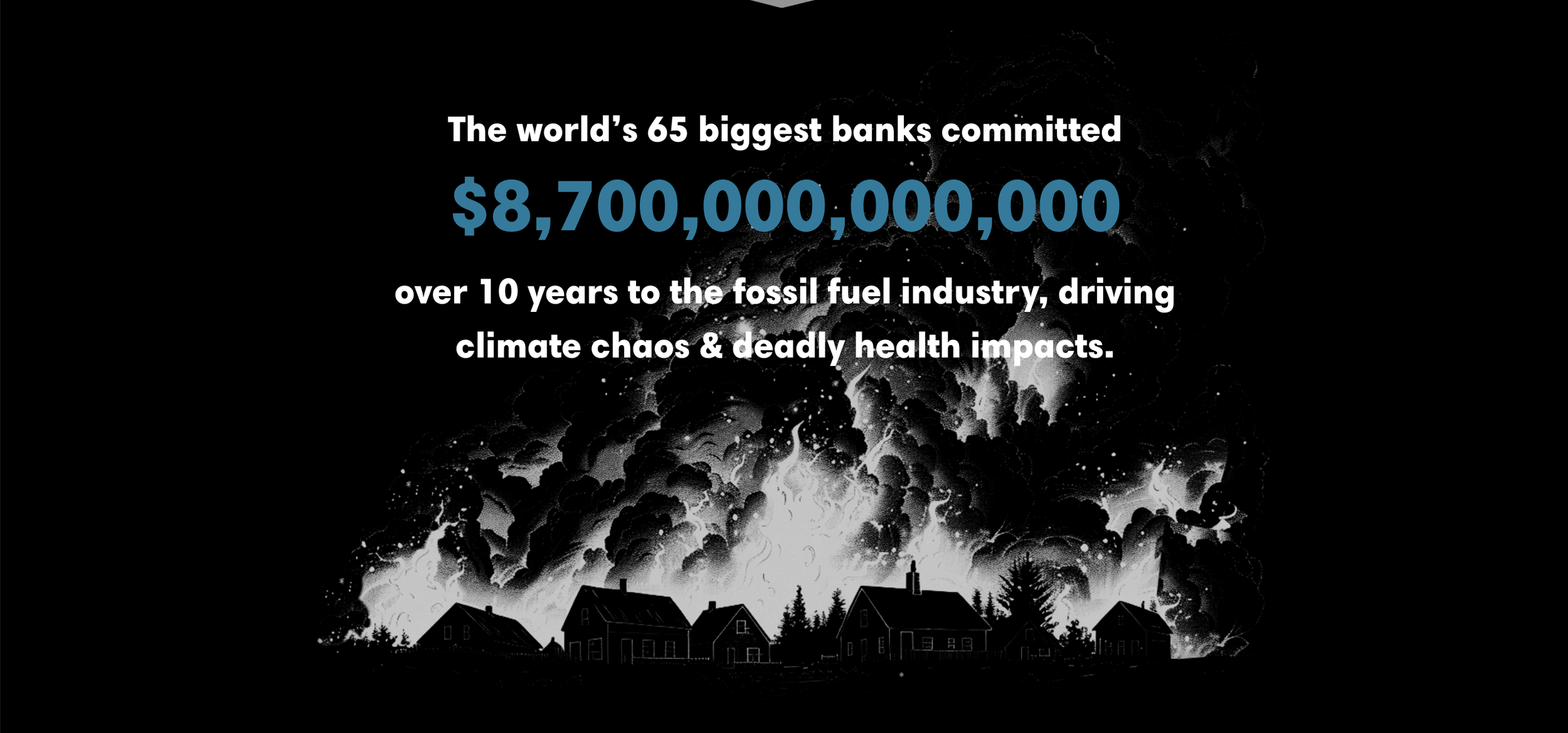
Although the evidence of fossil fuels' negative effects is clear, investment in them continues to rise rather than fall. In 2025, the world's 65 largest banks put $906 billion into fossil fuel companies, about 8 percent more than the year before. Since the 2015 Paris Agreement — in which nearly every country agreed to try to limit global warming to 1.5°C above pre-industrial levels, the threshold scientists tie to the most severe climate damage — these banks have provided $8.7 trillion. Staying under 1.5°C requires no further growth in fossil fuels, so a rising total moves in the wrong direction. 26 of the 65 banks did cut their fossil fuel funding in 2025, but larger increases elsewhere, led by US and Japanese banks, outweighed those reductions.
The fastest-growing money funds new projects. Of the $906 billion, $508 billion went to expansion — financing companies that are building new oil wells, gas pipelines, export terminals, and coal plants, rather than maintaining existing ones. That figure rose 27 percent in a single year. Expansion financing is the most consequential because new infrastructure is built to run for thirty or forty years; once it is built, there is strong financial pressure to keep using it long enough to recoup the cost, locking in decades of future emissions.
A small group of banks funds most of the growth in fossil fuels. Twelve banks — the report's "Dirty Dozen" — accounted for nearly 40 percent of all fossil fuel financing in 2025. JPMorgan Chase ranked first at $58.2 billion for the year, followed by Bank of America and Japan's MUFG. A large share of the global total is set by decisions at a handful of institutions.
Investing in fossil fuels means instability, not security
A central finding of this year's report is that dependence on fossil fuels has become a source of economic instability rather than security. During the Russia-Ukraine invasion in 2022, and again when conflict involving the US, Israel, and Iran disrupted supplies in 2026, energy prices spiked worldwide. A small number of fossil fuel companies and their largest shareholders earned record profits, while households and energy-importing countries absorbed higher bills, shortages, and economic strain. Over the same period, renewable sources such as solar and wind met all of last year's growth in global electricity demand and, for the first time, generated more power than coal.
Policy works better than promises
For years, banks have set their own voluntary climate policies — pledging not to finance Arctic drilling, for example, or joining the Net-Zero Banking Alliance, a group of banks that committed to reducing emissions over time. Those commitments can be reversed, and this year many were. The Net-Zero Banking Alliance collapsed in late 2025, and banks moved to weaken their own rules. Of the 15 large North American banks the report examined, 12 no longer place any meaningful limit on oil and gas lending; JPMorgan Chase and Goldman Sachs dropped their commitments against funding coal and Arctic drilling.
RRI has long held that durable environmental progress depends on enforceable policy, not voluntary corporate commitments that can be set aside under pressure. The report reaches the same conclusion, calling on governments and financial regulators — particularly in the few countries where most of this financing originates — to act.
Read the full report
Including full bank rankings, the underlying data, and each bank's policies
Source: Banking on Climate Chaos: Fossil Fuel Finance Report 2026, produced by the BOCC Coalition (Rainforest Action Network, BankTrack, CEED, Indigenous Environmental Network, Oil Change International, Reclaim Finance, the Sierra Club, and Urgewald).
